
Douglas County Bench Warrants Explained
A bench warrant is a judge's command to bring someone before the court. In Douglas County, the usual trigger is a missed appearance rather than a fresh charge. The case already exists on the docket. The warrant is simply a step inside that file. The county's own citation guidance says failure to appear can produce one, and the published warrant list tags each entry with a reason label naming the missed event. That label tells you what stage slipped. Since the order belongs to an existing case, the case number gets you a real answer faster than a name search alone.
Note: A bench warrant says the court wants the person present, and it does not establish what happened in the underlying case.
Douglas County Bench Warrant FTA Labels
The Douglas County warrant list and the court record both use short labels for missed appearances. Each label points to a specific stage of the case, and that stage decides what the court will want next.
- Initial appearance
- The first hearing after a charge, where the court covers the accusation and release conditions.
- Arraignment
- The hearing where the charge is formally put to the defendant.
- Omnibus
- A pretrial proceeding in a criminal case, often covering contested issues before trial.
- Jury trial
- A missed trial date, which the court treats as a serious failure to appear.
- Failure to comply
- A court-order problem that is not a missed hearing but is handled on the same file.
How Douglas County Bench Warrants Are Issued
Minnesota has a standard form for the ordinary failure-to-appear warrant. It is Rule of Criminal Procedure Form 8. Its full title is an application and warrant for obtaining a defendant's appearance after a failure to respond to a summons or citation. The form records that the earlier complaint or citation already established probable cause. It notes that the person did not appear, and it orders arrest and a prompt court appearance.
Key Rule: Form 8 directs that a person arrested on the warrant be brought before a judge without unnecessary delay and no later than 36 hours, or as soon as a judge is available.
That timing language is a promise about court process, nothing more. It does not promise any jail roster will show a hearing at a set hour. A Douglas County District Court judicial officer signs the order. The file stays with the court, while the sheriff's office serves it.
Missed Douglas County Court: Warrant Steps
Someone who realizes a Douglas County hearing was missed should act before a warrant appears, if that window is still open, and act fast once one exists. The same sequence of steps works either way.
- Find the case or citation number and the date of the missed event.
- Call Court Administration at 320-304-6050 and ask what the file requires now.
- Contact a licensed Minnesota attorney about a motion to recall or quash and about release conditions.
- If a warrant is already active, follow the county self-surrender instructions at the jail rather than waiting to be found.
Bring the case number to the first call and save yourself a return trip. Douglas County court staff can explain procedure and access, but only an attorney can advise on strategy for the case.
Bench Warrants and Arrest Warrants Compared
On a published Douglas County list, the two order types look alike and act differently. One grows out of a case already open, and the other usually opens a case.
| Point | Bench warrant | Arrest warrant |
|---|---|---|
| Typical trigger | A missed hearing or a court-order problem | A probable-cause finding on a new charge |
| Underlying case | Already open | Often the first step in the case |
| Issued by | A judge on the existing file | A judge after a complaint or application |
| First response | Contact the court and counsel | Contact counsel, then the jail route |
Minnesota also has a sign-and-release warrant under Minn. Stat. 629.415 for qualifying failure-to-appear situations. That category carries statutory conditions, so it never means the matter is finished.
Douglas County Bench Warrant Calendar Traps
The weekly public calendar is a handy tool that is easy to misuse. The Douglas County court posts a searchable PDF at 7:00 a.m. each business day and updates it hourly. Even so, confidential and non-remotely accessible matters may be left out. The court warns that a case missing from the PDF should not be read as canceled or rescheduled. So a blank line proves nothing. It is not a dismissal, and it is not a warrant either. The printed lobby calendar is the most current version. Court Administration is the office that confirms what a given case actually has scheduled.
Note: Check the posted calendar for context, then confirm the scheduled appearance itself with Court Administration.
Resolving a Douglas County Bench Warrant
A bench warrant clears through the court that issued it. The Douglas County court can recall or quash the order, set conditions, or reschedule the missed appearance. The court publishes no online recall form. That means the route runs through the court file and, usually, through counsel.
Caution: Paying a traffic fine is not a recall button. A payment can be treated as a plea, and it may leave a separate failure-to-appear issue open.
For anyone ready to appear, Douglas County keeps the self-surrender route at the jail open every day of the year. Arrive before 6:00 a.m. and staff will try to place the case on that day's court roster. The county calls it an attempt, not a guarantee.
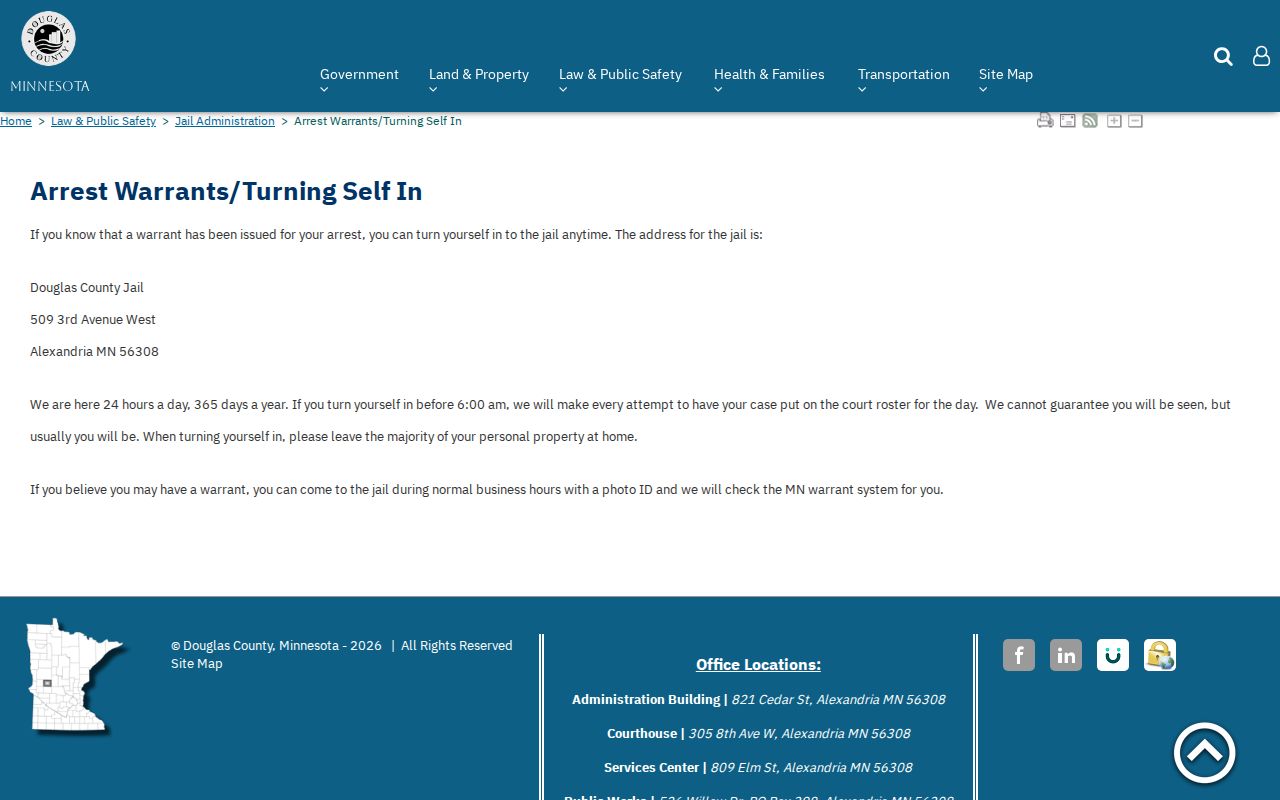
The county publishes self-surrender instructions covering the jail entrance, the identification to bring, and the property to leave behind. Photo identification is required. Current bail or bond figures come from the jail. The wider steps for clearing an order sit in the county overview of Douglas County warrant records.
Douglas County Bench Warrant Payment Myths
Two myths trip up people in Douglas County who miss a court date and try to fix it themselves. The first is that paying money settles the matter. For a citation, the county treats a full or partial payment as a guilty plea and a waiver of listed rights. Money and the warrant are separate questions. The second myth is that an old warrant just expires. There is no automatic expiration rule. A published entry can stay on the books even after the warrant was served. A court can recall or change an order, but neither fact means an old warrant is gone. Ask the Douglas County court what the file shows today.
Note: A citation number, a warrant number, and a court case number are three different identifiers, and each one routes to a different system.
Finding the Court That Issued the Warrant
Criminal and traffic cases across Douglas County land in the District Court, part of Minnesota's Seventh Judicial District. There is no separate municipal criminal court here. A citation written in any Douglas County city still ends up in the same trial court, which keeps the hunt for a bench warrant simpler than it looks. The first stop is Minnesota Court Records Online, where you can pull up the case file and read its details. Look for the party-level Active Warrant flag. Treat that flag with some care, since official guidance warns it can attach to a different case, so compare it against the file and against any other cases tied to the same person. If the online record is thin or the name simply does not appear, call Court Administration at 320-304-6050 or use the public terminal at the courthouse. A restricted view answers a question about access. It does not prove that no case exists.
Bench Warrant Status Versus the Douglas County List
A published entry and the underlying court file answer different questions in Douglas County. The list tells you a record was published on a certain date. It says nothing about what happened next, because the order may since have been recalled, served, or replaced. Reading both together guards against a wrong conclusion in either direction. Minn. Stat. 13.82 can keep certain arrest-warrant-index details confidential until custody, service, or an appearance, so a public page can never be treated as a complete index. Minnesota's public-data law presumes openness while allowing specific limits. Juvenile matters carry their own restrictions under Minn. Stat. 260B.171. For current status, Court Administration and the jail are the offices that can actually speak to it. The Douglas County list is where a warrant check starts, not where it ends.